'Ethnic Cleansing.' 'Terrorists.' 'Unlawful.' Britain Drops Its Diplomatic Guard and Confronts Israel Over the West Bank
LONDON — Ed Miliband stood at the despatch box of the House of Commons on Tuesday and said things that no British Foreign Secretary had ever said about Israel from that position.
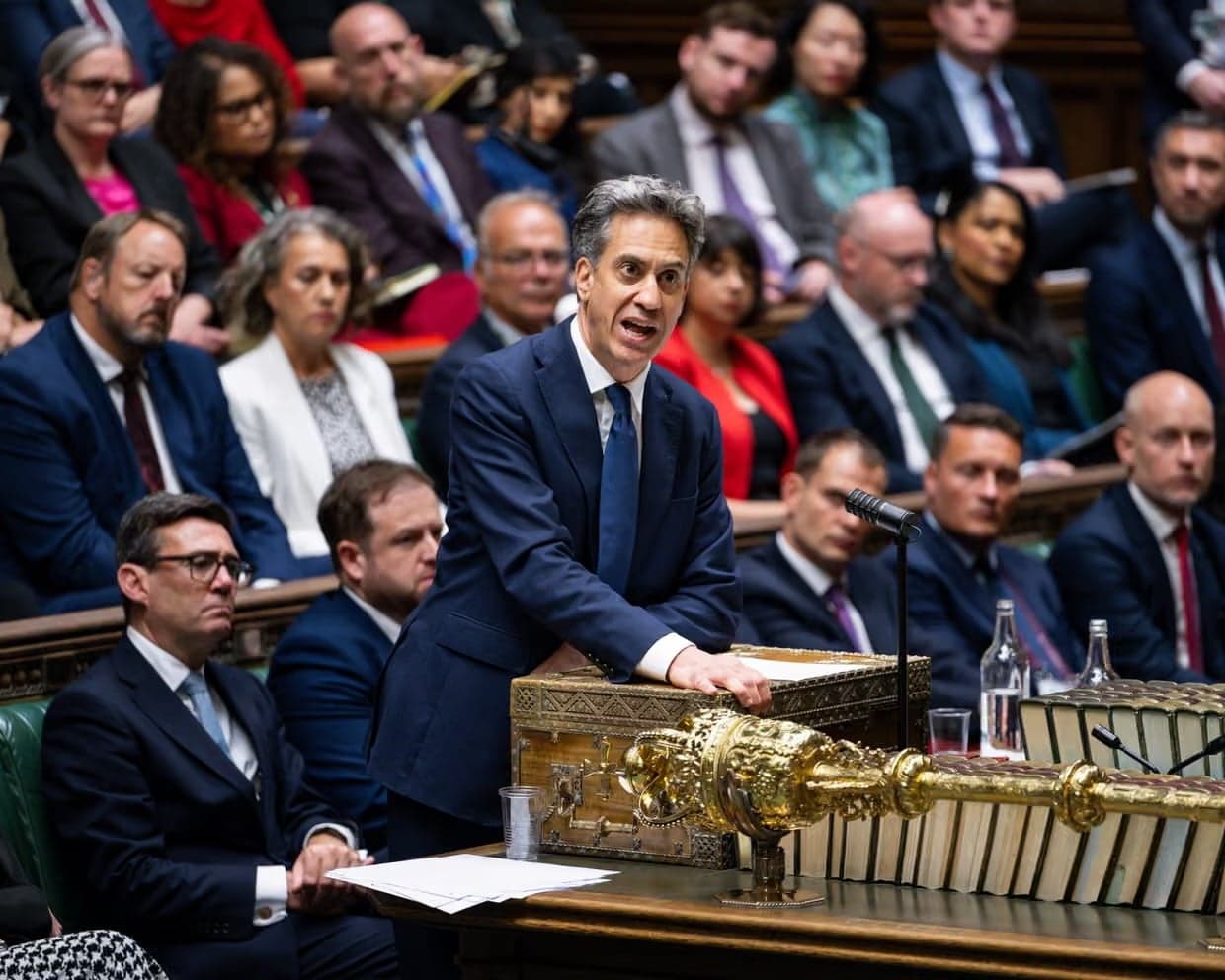
He called Israeli settlers "terrorists." He said they were carrying out "ethnic cleansing" of Palestinians in the West Bank. He declared it the official position of the British government that Israel's occupation of the West Bank is "unlawful." And then he announced what Britain was going to do about it — a comprehensive ban on the import of goods produced in Israeli settlements, targeted sanctions on individuals and companies involved in building, financing or advertising those settlements, tighter arms export restrictions, and a ban on real estate events held on British soil promoting the purchase of homes in the occupied West Bank.
The measures, Miliband said, represent a "comprehensive reset" in the UK's approach to Israel. The Israeli government's response came within hours: it announced it would close the British consulate in Jerusalem.
**What Was Announced**
The package of measures Miliband laid before Parliament on Tuesday is the most sweeping British policy action toward Israel since the UK recognised the State of Palestine under the previous Starmer government. It has four main components.
First, an import ban on all goods produced in Israeli settlements in the occupied West Bank. The measures are expected to take six to nine months to come into force. Second, targeted sanctions — asset freezes and travel bans — on a further set of Israeli settlers, and on corporate entities involved in constructing, advertising or financing settlement expansion. Third, an extension of the UK's existing ban on arms exports to include what Miliband described as a broader category of weapons and military equipment. Fourth, a ban on real estate promotion events in the United Kingdom selling properties in West Bank settlements.
Taken together, the package goes further than anything a British government has done in the modern diplomatic era to signal disapproval of Israeli settlement policy — and the language Miliband used to justify it went even further than the measures themselves.
**The Speech — and the Man Who Gave It**
Miliband opened his statement with a declaration that gave the language that followed its full weight. "I do so as a proud British Jew," he told the Commons, "someone with the deepest gratitude to the State of Israel for giving a home to my grandmother after she lost her husband, my grandfather, and 60 other family members at the hands of the Nazis." He described picking oranges as a child on a kibbutz where his cousins lived. He said Israel's right to exist as a homeland for the Jewish people was not in question — and that anyone who questioned it was wrong.
He then said what he came to say.
"The official view of the British government is that the occupation is unlawful," he told lawmakers. Extremist settlers had committed "ethnic cleansing" of Palestinians in parts of the West Bank, he said — "perpetrated by settler terrorists" — and the Israeli government had, too often, not merely turned a blind eye to this but had made statements and taken actions to support the displacement of Palestinians. "All too often, the Israeli government has turned a blind eye to this, and worse," he said.
He said he did not believe the British people wanted to support the occupation "by accepting products from settlements in our shops." He called the measures "a prelude to justice." And he framed the reset explicitly against the trigger that accelerated the timetable: Israel's final approval last year of the E1 settlement plan, which greenlit more than 3,400 new housing units east of Jerusalem — a development that diplomats have long warned would effectively bisect the West Bank and make Palestinian statehood geographically impossible.
**A Coordinated Western Move**
Britain did not act alone. The measures were coordinated with France and Canada — and in a joint statement issued after Miliband's speech, Prime Minister Andy Burnham, French President Emmanuel Macron and Canadian Prime Minister Mark Carney declared that "the time has come to take further action to uphold our commitment to protect the two-state solution."
Twelve countries in total issued a joint statement backing the two-state solution and announcing their own intentions to restrict trade with Israeli settlements. Joining the UK, France and Canada were Denmark, Spain, Finland, Ireland, Iceland, Norway, Poland, Portugal and Sweden. Several of those countries — Ireland, Spain, the Netherlands, Norway and Belgium — had already enacted similar restrictions. Denmark, Finland, Iceland and Poland were announcing new measures for the first time.
The coordinated nature of the response — twelve countries acting in concert, anchored by the UK's formal parliamentary declaration — represents the most significant multilateral diplomatic pressure on Israel's settlement policy since the United Nations Security Council resolution of 2016.
**Washington's Warning — and London's Defiance**
The Burnham government did not make Tuesday's announcement without knowing what was coming from Washington.
US officials and lawmakers had warned Britain in advance of economic consequences if it proceeded with the settlement sanctions — a warning that was calibrated to deter and that did not succeed. Britain proceeded regardless. It is one of the sharpest moments of divergence between London and Washington since the current administrations of both countries took office — the Burnham government, which replaced Keir Starmer's administration in July 2026 after Starmer resigned following internal Labour pressure, has signalled a more assertive independent foreign policy posture, particularly on the Middle East.
Separately, Miliband announced that the UK would reimpose strict economic sanctions on Iran — a move that provides some geopolitical balance to Tuesday's statement, though analysts noted that the Iran sanctions reimposition had been expected for months and was unlikely to be seen in Tel Aviv as offsetting the settlement measures.
**Israel's Response**
The Israeli government's decision to close the British consulate in Jerusalem was its most immediate and public act of retaliation. Israeli ministers and officials condemned Miliband's language in the strongest terms, with particular anger directed at the use of the words "ethnic cleansing" and "terrorists" to describe Israeli civilians — language that the Israeli government described as inflammatory, historically charged and unacceptable from an ally.
Finance Minister Bezalel Smotrich had attended a ceremony marking the establishment of the new Israeli settlement of Ma'ale Arugot in Gush Etzion in the West Bank just six days before Miliband's speech — the kind of public official endorsement of settlement expansion that Miliband's remarks directly referenced as evidence of governmental backing for settler activity.
**What It Means**
Tuesday's statement is significant not only for what it does — the import ban and the sanctions are real and substantial measures — but for what it says. Britain has, for decades, maintained a position on Israeli settlements that was critical in language and cautious in action. The Thatcher, Blair, Cameron, May and Johnson governments all described settlements as "illegal under international law" and "an obstacle to peace" while stopping well short of sanctions. What changed on Tuesday is that the words were matched with action — and the action was matched with words more direct, more blunt and more politically charged than anything heard before from a British foreign secretary.
Miliband is the son of Ralph Miliband, a Jewish refugee who fled Nazi-occupied Belgium for Britain in 1940. He introduced himself to the House of Commons on Tuesday by invoking that history. It is hard to imagine a more carefully constructed statement of personal authority for the words that followed.
Whether Tuesday's measures alter Israel's calculus on settlement expansion is a question that diplomacy will answer over months and years. What is already clear is that Britain, on September 8, 2026, chose a different kind of Middle East policy — and said so, plainly, in Parliament.
---