The King Who Stayed: Norway Buries Harald V as Europe Stands Still
OSLO, Wednesday — The bells of Oslo Cathedral rang three times. Then the country fell silent.
For one minute on Wednesday morning, Norway stopped. Shopkeepers stood still behind their counters. Drivers cut their engines. School corridors emptied of sound. Across the fjords and forests, in towns whose names Harald V had spoken at a thousand ceremonies across 35 years, the people who had known no other king simply paused and remembered.
Then the service began.
**The Last Journey**
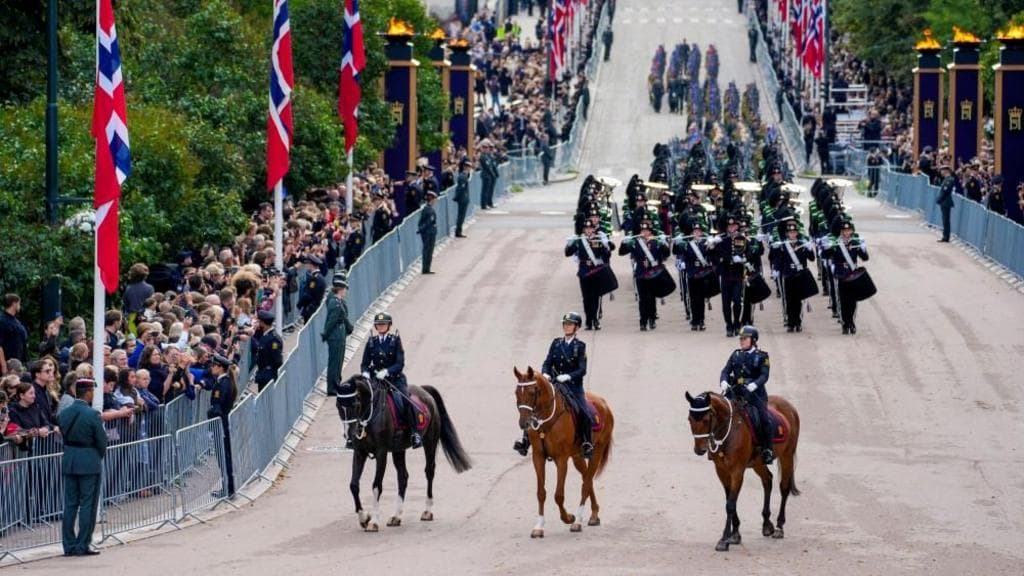
It had started earlier, in the grey Oslo morning, when a military escort left the Royal Palace for the last time with a king inside it. The coffin of Harald V — borne on a carriage, the Crown and the Sword of the Realm resting on top — moved through streets lined three and four deep with Norwegians who had come, simply, to see him one final time.
He had lain in state at the Royal Palace Chapel since August 31. Thousands had queued for hours across eight consecutive days to file past his coffin, to bow their heads, to say privately whatever it is people say to a king they have lost. Oslo mayor Anne Lindboe had postponed her own wedding — scheduled for August 28, the day Harald died — without a moment's hesitation. The Football Association of Norway suspended matches across seven divisions for 48 hours. Erling Haaland, whose king had received him warmly after the World Cup, posted a tribute and said very little, because very little needed saying.
A king had died. Norway grieved the way it loves — quietly, completely.
**The Cathedral**
Inside Oslo Cathedral, the world arrived to say goodbye.
Prince William sat among them — representing his father, King Charles III, who by British convention does not attend the funerals of other heads of state. Beside him, in a personal capacity all her own, sat Princess Anne — godmother to the man who is now King of Norway, Haakon VIII, and one of the few people in the cathedral who had known Harald's family across three generations.
They were surrounded by the crowns of Europe. King Felipe and Queen Letizia of Spain. King Willem-Alexander and Queen Máxima of the Netherlands, accompanied by Princess Beatrix and the young Princess Amalia. King Philippe and Queen Mathilde of Belgium — Philippe, Harald's first cousin, a man who shares his bloodline. Frederik X and Queen Mary of Denmark. Crown Prince Fumihito of Japan, representing Emperor Naruhito, just as Naruhito's own father had attended the funeral of Harald's father, Olav V, in this same city in 1991. Prince Albert and Princess Charlène of Monaco. The flags of Monaco had flown at half-mast since dawn.
Among the statesmen sat Volodymyr Zelenskyy, the Ukrainian president — a man who attends European gatherings these days with the war still burning at his back, whose presence in any room is a reminder that Europe's peace is not as permanent as its cathedrals make it feel.
Olav Fykse Tveit, Preses of the Norwegian Bishops' Conference, presided. The Bishop of Oslo, Sunniva Gylver, assisted. The Oslo Cathedral Choir filled the vaulted space with music. The President of the Storting spoke. Prime Minister Jonas Gahr Støre — who eleven days earlier had told his country it was "united in grief and gratitude" — spoke again. And then the bells tolled. Three times. Norway went silent.
**The Man They Were Burying**
Harald V was born on February 21, 1937 at Skaugum in Asker, the only son of Crown Prince Olav and Crown Princess Märtha. He came to the throne on January 17, 1991, the day his father died, and he never left it. Thirty-five years. Through the transformation of Norway from an oil-rich North Sea nation into one of the wealthiest and most stable societies on earth. Through the rise of the internet and social media and a world his grandfather could not have imagined. Through his own heart surgeries and hip replacements and pacemakers and hospitalisations — through all of it, he stayed.
When the kings and queens around him abdicated — and many did — Harald refused. He had watched his father reign until death. He intended to do the same. He was, at the time of his passing, Europe's oldest serving monarch. He died, as he intended, a king.
He had also, once, been a man in love with a woman he was not supposed to marry. Sonja Haraldsen was a commoner, a merchant's daughter, and royal convention did not smile on the match. Harald waited nine years. He waited because he loved her. His father eventually gave his blessing. The marriage lasted until Harald's final morning — 58 years, from 1968 to 2026, a love story that outlasted nearly everything.
He was also, improbably, a world-class sailor. Three Olympics. A World Championship gold in 1987. A European Championship gold in 2005. He competed not to be seen competing but because he was genuinely, seriously good. It was of a piece with the man — no pretence, no performance, no distance between the king and the person.
**After the Cathedral**
After the service, a cortège carried Harald V to Akershus Fortress — the medieval castle that stands at the edge of Oslo's harbour, overlooking the fjord he loved to sail. In the Royal Mausoleum beneath it, he was laid to rest beside the kings who came before him.
His son, Haakon VIII, who took the oath of allegiance to Norway's constitution in parliament just last week, stood and watched his father go into the ground. He is 52 years old. He has been prepared for this moment his entire life. He is king now.
Norway emerged from its minute of silence, from its cathedral, from its streets and its queues and its postponed weddings and its half-masted flags, and began the work of being a country whose king had died.
He had given them 35 years. He had refused to leave early.
That was Harald.
---
More in World